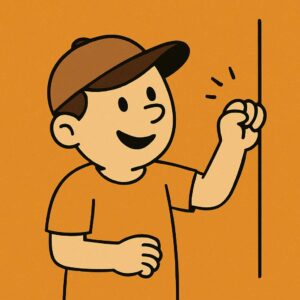
If you’ve spent any time around kids ages 4-8, you’ve heard approximately ten thousand knock-knock jokes. Some of them make sense. Most of them don’t. And yet, kids think they’re absolutely hilarious.
Here’s the thing: there’s actually a reason for this, and it’s not just that kids have terrible taste in humor (though, let’s be honest, sometimes they do).
The Structure Is the Point
Knock-knock jokes follow a rigid pattern. Knock knock. Who’s there? [Name]. [Name] who? [Punchline].
For little kids, this predictability is the magic. They know exactly what comes next. They feel in control of the conversation. And when the punchline hits, they get to experience surprise within a safe, familiar framework.
It’s like the humor equivalent of training wheels.
Why This Matters Developmentally
Around age 4-5, kids start understanding that words can have multiple meanings. “Lettuce” sounds like “let us.” “Orange” sounds like “aren’t.” This is a huge cognitive leap.
Knock-knock jokes let kids play with this discovery. They’re essentially practicing language skills while having fun. Every time they tell a pun-based knock-knock joke, they’re demonstrating that they understand wordplay.
So when your kid tells you a knock-knock joke for the fifteenth time today, they’re not just being annoying. They’re literally building their brain.
The “Nonsense Joke” Phase
Here’s something every parent knows: kids go through a phase where they make up their own knock-knock jokes, and they make absolutely no sense.
“Knock knock.”
“Who’s there?”
“Banana.”
“Banana who?”
“Banana SHOE!” [hysterical laughter]
This is normal. They understand the structure before they understand what makes something actually funny. They’re experimenting. Eventually, they figure out that the punchline needs to connect to the setup, and their jokes get better.
Or they become that one uncle who still tells bad jokes at Thanksgiving. Either way.
How to Encourage It (Without Losing Your Mind)
Teach them a few good ones. Give them material that actually works. This helps them understand what makes a knock-knock joke land.
Laugh anyway. Even when the joke makes zero sense. You’re rewarding the effort, not the execution.
Play along with the bad ones. Ask follow-up questions. “Why banana shoe?” Sometimes their explanation is funnier than the joke.
Set boundaries if needed. “We can do five more knock-knock jokes, then we’re taking a break.” Your sanity matters too.
Classic Knock-Knocks to Teach Your Kids
Here are some that actually work and are easy to remember:
Knock knock.
Who’s there?
Boo.
Boo who?
Don’t cry, it’s just a joke!
Knock knock.
Who’s there?
Lettuce.
Lettuce who?
Lettuce in, it’s cold out here!
Knock knock.
Who’s there?
Cow says.
Cow says who?
No, cow says MOOO!
Knock knock.
Who’s there?
Interrupting cow.
Interrupting cow wh—
MOOOOO!
That last one teaches them about timing and subverting expectations. Advanced stuff.
When Jokes Get Better
Around age 7-8, most kids start telling jokes that actually make sense. Their wordplay improves. They start understanding irony. They can read the room a little better.
This is when you can introduce them to other formats: one-liners, riddles, puns. They’ve graduated from knock-knock training and are ready for the wider world of comedy.
FAQ
What age do kids start telling knock-knock jokes?
Most kids discover knock-knock jokes around age 3-4, though they usually don’t “get” them until 4-5. The peak knock-knock obsession is typically ages 5-7.
My kid’s knock-knock jokes don’t make sense. Is that normal?
Completely normal. They understand the format before they understand the humor mechanics. It’s like how kids bang on a piano before they learn to play. Give it time.
Should I correct my kid when their joke doesn’t work?
Gently, and not every time. You can say something like “That’s silly! What if the punchline was [better version]?” This teaches without crushing their enthusiasm.
Are there any knock-knock jokes I should avoid teaching kids?
Stick to clean, simple ones. Avoid anything with adult themes or mean-spirited punchlines. At this age, you’re teaching them that humor should be fun, not hurtful.
How do I get my kid to stop telling knock-knock jokes constantly?
You probably can’t completely stop it, but you can redirect. Try teaching them riddles or other joke formats. Or set “joke time” boundaries. Eventually, they move on to the next obsession.
—
Ready for more? Check out our knock-knock jokes for preschoolers or browse our full kid jokes collection.